Category: Self-Employment Insights

  • Should You Get Certified?

    |

    There was a long discussion on Twitter yesterday about whether you should get certifications or not. While the answers were all over the place, there were a number of common refrains. The general consensus was that experience is always better when possible, but that a certification is better than nothing.

    This being a complex topic, I thought I’d lay out the various factors to give a more comprehensive answer than you can easily fit in a tweet.

    So the first two questions we need to answer are “Why do certs exist?” and “Why do people take them?”. Without these, we can’t give a good answer to whether you should take them. Certifications often exist for reasons that have nothing to do with your personal best interest. It is necessary to understand that fact.

    Why do certs exist?

    A vendor like Microsoft does not create a certification as an act of charity. Certifications are an expensive thing to create. I wrote all of the questions for the Pluralsight Power BI skill assessment and it was a gruelling process. I was asked to write at a different level of understanding and to try to have plausible distractors as wrong answers.

    While they do charge money to take a certification exam, I suspect Pearson takes most of that money and Microsoft likely breaks even, if anything. Oracle, on the other hand, charges quite a bit for their certifications. So we have to ask, why would Microsoft or another vendor create a certification? These driving factors will shape the content inside a certification, so it is important. A few reasons come to mind:

    1. Marketing
    2. Business/partner relations
    3. Technician adoption
    4. Market driver

    Now it’s worth saying that these reasons apply specifically to a third party vendor. Platform neutral companies like CompTIA are trying to act as an accreditation body and have different motivations.

    Marketing

    Certifications are a marketing tool. They are a way to highlight new features in a new version of SQL Server, for example. That highlighting is also done out of necessity so that people can’t auto-pass the latest version of a certification.

    Additionally, having certifications looks good on a company and is an indicator that the technology is fully-baked. I remember years ago looking into Vertica, a niche columnar database engine way before the time of Power Pivot. I remember looking into getting certified in the technology and thinking “Okay, they are pretty niche, but they have a certification path, so there must be something here.”

    The same thing could apply to Microsoft and newer technologies like Power BI. It took a number of years for Microsoft to come out with a certification for that technology, in part because it changes so quickly. I could easily see an IT manager that is considering adopting Power BI using the existence of certifications as a sign that a) there is a path forward and b) Microsoft has made an investment and is unlikely to dump the technology.

    Business/partner relations

    Businesses need a way to assess the skill level of job applicants as well as growing employees. Certifications, along with college accreditations and years of experience are ways to measure someone’s skill level. Now, certifications aren’t necessarily a good way of measuring skill level. Often they measure memorization skills, certifications can be cheated, and sometimes certifications are out of date with the real world. But they are quick and easy from a business perspective.

    At my last job, if I recall correctly, to get to level 2 on the help desk you had to pass the CompTIA A+ exam. This served as a clear bar of entry, and because turnover was so high on the helpdesk, reduced the amount of work assessing the skill of people who were likely to be gone in a year anyway.

    Microsoft has a similar problem with Microsoft partners. Microsoft wants as many partners as possible, as long as they are competent and credible. So, how does Microsoft give a partner their stamp of approval without going through and an expensive auditing and assessment process? They use 3 criteria:

    1. Social proof. To become a Microsoft partner, you need 3 customers that will vouch for you.
    2. Certifications. You are expected to have 1-2 people with certain Microsoft certifications.
    3. Capital. You need to pay a certain fee to become a Microsoft partner.

    Technician adoption

    It is in Microsoft’s best interest for there to be a clear path forward for people to learn their technologies in order to increase technician adoption. If they want technicians to start using Azure, for example, there needs to be a smooth path from remembering to understanding to application.

    Certifications represent a small piece of this, along with training materials, Microsoft conferences, evangelists and so on. In theory, certifications represent a stepping stone to becoming an expert in a new technology.

    Market Driver

    Did you know that Microsoft desperately wants you to learn PowerShell? They likely see it as a key differentiator and a way for them to stay relevant in the age of DevOps and infrastructure-as-code. So, let’s say that you are an executive at Microsoft and you want more people to use PowerShell, how do you accomplish this?

    Well, one option is to add it as a requirement to many of your IT Ops certifications. And that’s what Microsoft has done. If a vendor has a large enough base of people taking exams, they can drive what people have to learn via the certification requirements.

    Why do people take certification exams?

    There are two reasons people take certifications:

    1. Accreditation
    2. Learning a technology

    The important question is are they good for either of those?

    Accreditation

    In terms of accreditation, certifications are a mixed bag and can even be a negative indicator. By definition, the things that are easiest to write for standardized tests for fall near the bottom of Blooms Taxonomy. And so despite a decent variety in the types of questions Microsoft uses, tests are naturally going to cater more toward people who are good at book learning and memorization.
    image

    Another issue is that is often easy to cheat on a certification. Testing centers do a good job of watching your conduct and verifying your identity. So in-person fraud isn’t an issue. However, it’s pretty easy to find dumps of the exact questions used on an exam. I once had a co-worker that had accidentally used a dump to study and was asking the team about the right answer on a question. I pointed out to him that that was a verbatim question from the exam I had just taken.

    Microsoft is making strides to address these two issues by introducing labs into their new role-based certifications. This will address the roteness and cheating.

    Compared to what?

    An important piece of this is compared to what. The general consensus was that real, hands-on experience is almost always better than certifications. But for many new to the field, especially if you don’t have a bachelor’s degree it can be a catch-22. You need experience to get a job and you need a job to get experience. Certifications can be a way to break this paradox, along with internships, boot camps, MOOCs, home labs and side projects.

    Another issue is if you are settled in a job and want to pivot in another area. For example, let’s say you are a DBA that wants to pivot into Machine Learning. Part of the challenge is you are likely not gaining direct experience in your current position. Getting a certification in machine learning could help show that you have enough knowledge to make that transition.

    If you have the option to do an internship or a real project, I would recommend that over getting a certification. But lacking that, a certification is a decent option and much better than nothing. Just be aware that the content can be skewed and not always in line with the latest best practices.

    Who is looking at them?

    Another thing to consider is who is going to be looking at the fact that you have a certification? As I said, they can be a bit of a mixed bag and I believe that IT managers understand that fact.  However, in many organizations, it isn’t IT who is the first pass but HR. HR, by not being domain experts, are more likely to lean on easy metrics and more likely to value certifications. In a pile of resumes, a certification could be what gets you past the first filter.

    Learning Path

    The other reason people get certifications is as a way of learning. The general opinion on this is decidedly negative.  Much of this is because of the skew we talked about towards new features and memorization. An ideal certification exam would give you a real problem and force you to solve it with the tooling. The second half of the Microsoft Certified Master was like this and was very well respected. It was also expensive and cost thousands and thousands of dollars to take.

    Additionally, if you are just looking to learn, there is a vast set of free and cheap resources to learn. Often times you would be much better off with a technical book and a home lab, just banging away at real-world tasks.

    But that being said, I have a much more positive opinion of certification exams. I think a lot about a quote by Donald Rumsefeld:

    Reports that say that something hasn’t happened are always interesting to me, because as we know, there are known knowns; there are things we know we know. We also know there are known unknowns; that is to say we know there are some things we do not know.
    But there are also unknown unknowns—the ones we don’t know we don’t know. And if one looks throughout the history of our country and other free countries, it is the latter category that tend to be the difficult ones.

    When you are just first starting with a technology, it is utterly overwhelming how many moving pieces there are. I find certification invaluable in getting a lay of the land and addressing those unknown unknowns. Certifications can be a way of getting past impostor syndrome and feeling like you understand a technology.

    Are certifications skewed and sometimes wrong? Yes, absolutely. But they are also generally comprehensive and touch upon a wide swath of subjects. I think a lot of when I got my second certification, specifically on SQL Administration. I remember reading about high availability and thinking “I don’t need to know this, we have like 2 SQL servers.” Which was true, until I accidentally became a consultant and was configuring mirroring for customers.

    Summary

    Certifications are a flawed tool, often skewed toward certain subjects, outcomes and types of learning. But despite all of their flaws, they can be a way to get your foot in the door somewhere or get a broader understanding of a technology. They shouldn’t be your first choice, but they shouldn’t be ignored either.
  • The real reason to become self-employed: being a caretaker.

    |

    Normally, I’d spend a few hours writing some eloquent 1,000 word blog post, with a dozen sub-headers and very mild puns. Today is not one of those days, as much as I want to make sure I do the topic justice. I’d rather get this written than push it out.

    My rickety raft

    If you are looking to become an independent consultant for the money, welll I’d advise against it. I wrote before about lessons learned and while you can make a lot of money, it’s a big slog and a big stress. I would compare it to trying to build a big wooden ship, from a rickety raft while you are using the raft.

    Only now, about 5 months in, are things stable enough that I can relax. Our finances are solid for the next 3 months and we’ve finally gotten some walls on our raft. It’s still ricketey, but it’s going to take more than any single wave to topple us. It will likely take the rest of the year to get things completely stable.

    If I was looking to make more money, the smart move probably would have been to take a job with “Senior” in the title and get a 20k pay bump.

    The real benefit

    There are a handful of reasons why I made this leap. I was tired of feeling overworked, I wanted to give this a shot, I wanted to work less hours, I wanted to travel more and give more presentations, etc. But a least a third of it, was knowing that in 5 years, or 10 years stuff was going to hit the fan with my mom.

    I’m currently the primary caretaker for my mom. She lives independently and gets a lot of services from a Medicare replacement program, called Life Beaver County. I usually describe it as adult daycare meets medical center. They clean her place once a week and have nurses make sure she takes her medicine. For a while, my responsibilities were just grocery shopping every week and occasionally taking her out to go shopping.

    But in the back of my mind I knew that as some point those needs were going to escalate. I knew at some point down the road there was going to be a year where she wasn’t well enough to live totally independently but not ill enough to go into assisted living. And very recently, I’ve gotten a, ahem, new commute.

    My new commute

    Things had escalated recently to the point where I knew that if my mom didn’t get more care, her physical and mental health were going to deteriorate. And so, somewhat reluctantly, I decided to start driving my mom to Life Beaver County every morning.

    I am utterly blessed to be able to do so. While it’s a pain to spend 60-90 minutes every morning waking up my mom, getting her ready, taking her in; I am truly lucky to have it as an option. Right now I’m optimistic that her physical and mental health are going to greatly improve and that this could be the difference between being in a home in 10 years instead of 2.

    Working for yourself is an utter pain. It requires a whole new set of skills as difficult as learning to be a manager, in my mind. But it also brings some options that just aren’t available with most jobs.

  • Lessons learned from being self-employed, 3 months in

    |

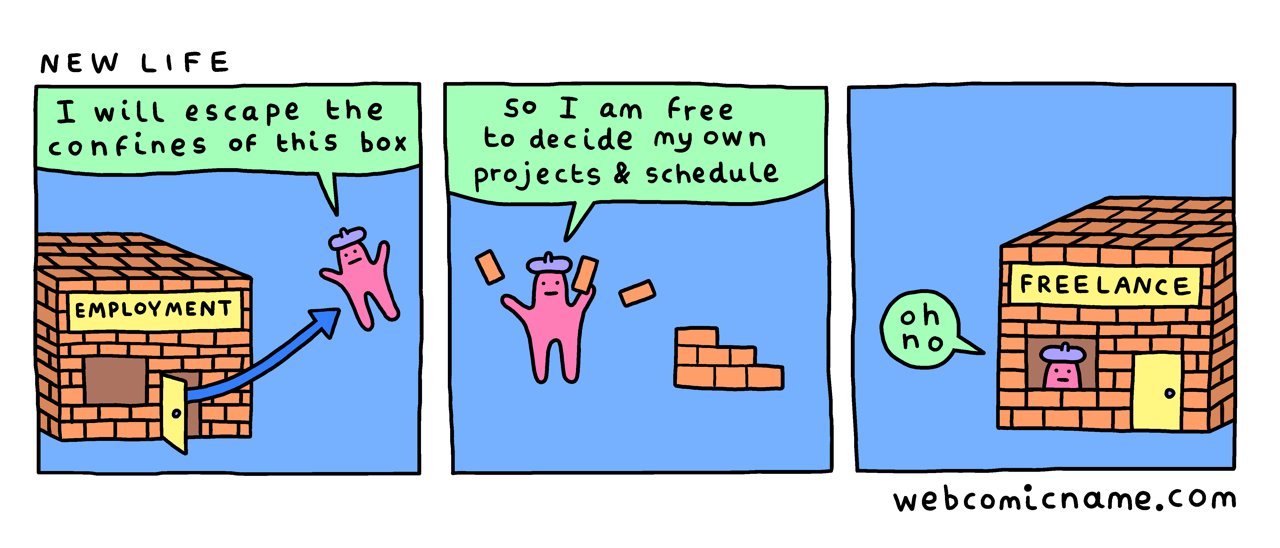
    Back in September, I quit my job to work for myself. While I don’t have any regrets, I’ve certainly been doing a lot of thinking. I’ve been thinking about what this job means for me and where I’m going next. Being self-employed has been full of surprises. This recent comic by Alex Norris sums things up well:

    image

    So what have I learned  so far?

    You are soft, squishy and frail

    I quit my job for a number of reasons. Partly because I felt like I was stagnating and busy supporting legacy applications. Partly because I was feeling stressed out and overworked. My weight has been steadily increasing for the past year as well as my A1C. It was time for something to change.

    I mention this because trying to jump from one stressful situation to another can compound issues. Changing jobs is one source of stress. Working for yourself is another source of stress. Working from home for the first time is another source of stress. When you add these all up, the biggest hurdle I’ve run into is acknowledging my own limitations. When you work for yourself, self-care and self-management become the most important skills you can have.

    I’ve never been good about acknowledging my own needs. I hate the phrase “self-care”. To me it evokes images of decadent bath soaps and floral scented candles. But a lot of it comes down to sacrificing the immediate for the prudent. Exercising, sleeping, taking breaks, eating health, etc. It involves being humble enough to acknowledge that having needs doesn’t make you weak. It involves acknowledging that you are soft, squishy and frail.

    The consequences of not taking care of yourself are amplified when you are self-employed. When you have a normal job, you have to get dressed and go to work, whether you feel like it or not. In contrast, if you have a bad day working from home, you might feel demotivated and get less done the next day, and so on and so on. When you work for yourself, all the guard rails come off.

    When I first made the switch, I found myself going into a depressive episode. My third course wasn’t paying out yet, I didn’t know if I would find work, and I was in a difficult contract negotiation with a potential client. Things are going much better now, but the specter still looms as the days get shorter here in Pittsburgh.

    Working from home is utterly lonely

    I’m naturally an introvert. If you and I have a conversation, it’s like a little taxi meter starts running. I may deeply, deeply enjoy the conversation and find it incredibly exciting, but it still taxes my energy levels. Small talk even more so. Imagine that every time someone chatted about the weather, you had to pay the same price as a Lyft ride to go 4 blocks. That’s how I feel about small talk.

    That being said, we are still social creatures, and even introverts need human interaction. Especially so when you need to think through new situations, new problems. One of the things I realized attending PASS Summit is that I need social interaction to thrive. So now I spend a lot more time on Twitter and am part of a peer group of authors. I work down at the library whenever I have the chance.

    Your brain is dumb and thinks you are at work

    Working whenever you want is a terrible, terrible idea. While you, intelligent person, may understand the idea of working whenever you want, your brain is dumb and now thinks you are at work all the time. On top of that, now you have to make the regular decision “Do I want to work or take a nap?”. Set regular office hours and stick to them.

    In addition to that, if possible get a separate office space. I have a separate room, but right now I use the same laptop for everything. Eventually I’ll buy a computer just for work. In the meantime, I’ve been trying to use my PS4 more and get out of the office when I’m not working.

    It is important to make as many dividing lines between home space and work space as you can. Same for delineating leisure time and work time. If you don’t, it all becomes a blur and you feel this vague dissatisfaction.

    You will work too much, too little and for long periods of time

    Never underestimate the power of social norms and peer pressure. At a normal job, you are much more likely come and work for the normal set of hours. But when you work at home, it’s really easy to work a 6 hour day. It’s also easy kick yourself for doing this, and work on the weekends to try to compensate.

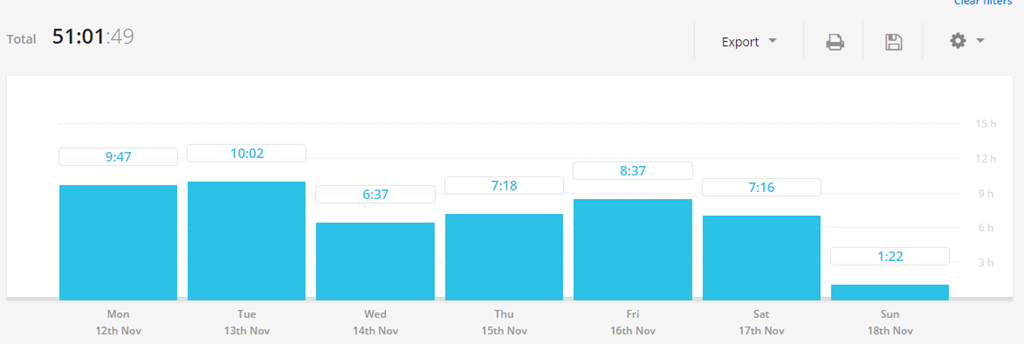
    Some weeks you might work 30 hours and some weeks you might work 50. Here’s a recent 50 hour week.

    image

    This “flexibility” is at times convenient, but in the long run it isn’t wise. Because your success depends entirely on you, there is the temptation is there to work more and more. This is especially true when you are just trying to get things going. Again, setting office hours and sticking to them is important.

    Another issue I’m running into now, is that I no longer have a good reason to take breaks. At my old job, I’d get up, walk around, get a drink, chat with coworkers. Because I was doing a lot of task switching, it was easy to find good times to take breaks.

    Now, I’m working much larger chunks which means I have to force myself to take breaks. Currently I’m forcing myself to follow the pomodoro method, taking 5 minute breaks every half-hour whether I feel like it or not. This has helped me focus more and has made work less of a blur.

    This goes back to the self-care and self-management thing. I feel utterly silly forcing myself to take breaks and walk around. Like some child that needs to be reminded, “Okay, now get up and stretch!”. But productivity isn’t a natural state of affairs, at least it isn’t for me. And if I want to be successful in my new job, I’m going to need to keep my ego in check.

    Time is money and money takes time

    When you start to work for yourself, you are going to think about money. A lot. And if you don’t, it’ll make you think about it. I’ve overdrafted on my bank account 3 times now, and each time I feel like an idiot. It’s not that we don’t have the money. The problem is we have 4 different bank accounts that need consolidated.

    This was never a problem before. First we always had enough savings to cover any expenses. Second, I had a paycheck coming in every 2 weeks. Now that I work for myself, the expenses still go out monthly, but income doesn’t come in every 2 weeks.

    Every dollar is a hustle and a hassle

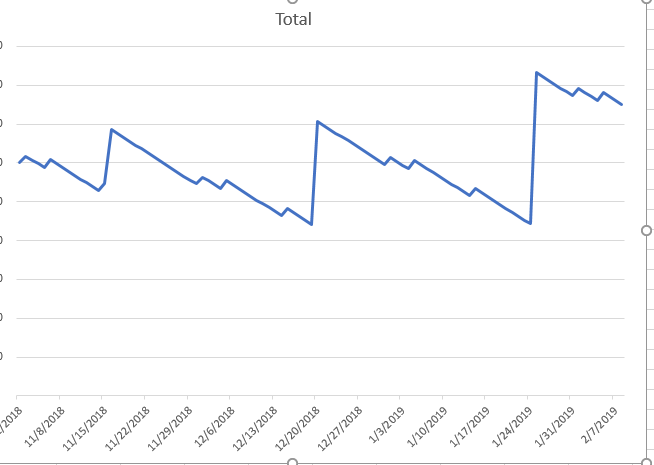
    The first reason you starting thinking about money more is because it’s no longer guaranteed.  I underestimated how convenient it was to have money coming in on a regular basis. It was so much easier to budget for the household and plan expenses. Now I have to bust out excel and do cashflow planning. You’ll notice how jagged the big spikes are.

    image

    That downward trend will keep happening regardless of what I do. But those spikes up only happen if I make them happen. It feels very much like this Sisyphean task of pushing our savings boulder up the hill and then it rolls back down.

    People take forever to pay you

    Not only do you have to think about doing work to get money, but you have to think about when it will come in.  $2,000 today can be worth a lot more than $4,000 in six months. On the one end of the extreme, I have a customer that prepays me for 40 hour blocks of work at a 20% discount.

    At the other end of the extreme, my courses pay out quarterly plus I released in mid-October I won’t see any royalties until late January. When you are worrying about paying the bills today, this is a nightmare. But the courses are lucrative over the long term, so I need to make sure I keep making courses.

    Another factor is unexpected delays. Delays with agreeing to a contract. Delays with agreeing to the scope. Delays with the customer changing their mind on a piece of work. You can never count on a future piece of income until the check is signed and in the mail.

    The distance between action and result gets longer

    When you work a 9-to-5 kind of job. You put in a certain number of hours every week and get paid a certain number of dollars every two weeks. Even if you are a salaried employee, the distance between inputs and outputs is pretty straightforward. When you are freelance, everything gets murky.

    First, a lot of the work that I do has long term deadlines. If am making a course, I will work on that course for 4-6 months and not see any money until it is completed. If I’m writing a paid article, the cycle is shorter but there is still a delay.

    Now, for customers that I bill time and material, it’s a lot simpler in theory. But the sales cycle to get that customer is still a numbers game. Everything in the sales cycle is like buying little tiny lottery tickets with your time and energy. You have no idea which one will pay off, so you buy a lot of lottery tickets.

    To start with is marketing. Marketing is the act of realizing that most people, by default, have no idea who you are and don’t care. I spend an hour every week writing my newsletter. What’s the dollar value on that? No idea. When will it pay off? Maybe years down the road. Every newsletter issue is a tiny, tiny lottery ticket.

    Once people know you exists, you have to deal with the sales process. First you have to talk with people that might be interested in your services, a.k.a. leads. Then you narrow them down to people who are actually interested in your services, a.k.a qualified leads. Finally, you have to scope the project, submit a proposal, and hope it gets accepted. Once you do the work, you go back and hope they have more work for you.

    This cycle can take weeks or even months. Tiny, tiny lottery tickets. So much of sales and working for yourself is playing the marshmallow game. Do you eat one marshmallow now, or do you wait and hope for two later?

    Your skillset and your job role get blurry

    When I initially made the switch to freelance, I thought I was going to become a fulltime course author. As I picked up consulting work to help pay the bills, I’m realizing that a blend probably makes more sense. So I would use course authoring to provide a stable base of income and use consulting to stay sharp.

    Off-brand consultants

    If you are going to do consulting, you have to deal with another piece of marketing called branding. If marketing is making sure people know you exist, branding is deciding what you want to be known for. I’ve written before that people pay for specialization. This is doubly so in consulting. A recent customer told me, “If I’m going to pay you, I need to make sure you know more than my team.”

    This has two consequences. First, is that any work you do that’s off-brand is time you could be spending going deeper on what you want to be known for. For example, I’m doing Xamarin development for my old employer. This helps pay the bills today, but is taking away from Power BI work I could be doing to grow my expertise.

    The second consequence is that your training plan becomes more forward looking. In my prior job, my learning was heavily driven by my immediate tasks. At times this lead to a learning plan that was a mile wide and an inch deep. Now, my learning is driven by where I want to go as a person, as a business, and as a brand. For me that means learning more about SSAS, data modelling, and good report design. Not C#, not Docker, not PowerShell, not Kubernetes.

    Don’t get me wrong, those are all exciting and powerful technologies that are going to be extremely important over the next 5 years. But as a consultant, the benefit of specializing is much higher than normal. Once you are established, then you can start to branch out more.

    Learning soft skills is hard

    But wait, it’s not so clean cut. We were only talking about technical skills. But when you work for yourself, there are an array of soft skills you need to learn. The first are business skills: reading contracts, marketing, sales, accounting. There are a ton of things you just never had to deal with as a regular employee.

    The other set of soft-skills are what you normally think of: writing, communication, time management, etc.These become more important when you work for yourself. So much of consulting is being able to build relationships and communicate clearly. So much of working from home is being able to manage your time and your focus.

    Summary

    Like I said, I don’t regret the decision to work for myself. It gave me a soft landing from my last job and is giving me the time to think about what I want my career to look like. But it is a lot of new things to learn and is, at times, overwhelming. Right now I don’t know if this is something I’ll be doing for the next decade, or it is more of a gap year. We’ll see!

  • I’m starting a BI newsletter. 5 BI links every week.

    |

    I’ve written before about how to keep up with technology. In the post, I describe 3 currencies we can spend to extend out learning: time, focus and actual money. As you get older, you start to get less time and even less focus, but your pay rate goes up. So, every year it becomes more and more important to learn on curation to find just the good stuff.

    As part of that I’m starting my own curated mailing list for BI links. Power BI changes on a monthly basis and it’s such a pain to keep up with it. This week is the 3rd week so far.

    So what’s the catch? Well, I’ll also be including whatever things I’m up to at the bottom of each email. So if you don’t like me, maybe don’t sign up, hah. Here is this week’s weekly BI 5:

    1. David Eldersveld talks a bit about #MakeoverMonday. This sounds like a great community program and I always find making things pretty to be the hardest part.
    2. Wolfgang Strasser is keeping track of all the November updates for Power BI. I keep seeing memes about this from Microsoft employees, so I’m expecting something big to drop at Pass Summit.
    3. Ginger Grant continues her series on SSAS best practices. I love seeing posts about how to do things right instead of just how to do the basics. Great stuff.
    4. Chris Webb also my conspiracy theories about where Power BI is going. Also keep an eye out for announcements about data flows.
    5. Finally, If you are going to PASS Summit, check out the BI Power Hour. All learning will be accidental.

    Sign up to the list today!