Sh*t sucks right now.
Microsoft is explicitly positioning Fabric Apps as the next chapter or next evolution of Power BI reporting. LinkedIn Gremlins dance on the still-warm grave of Power BI, more concerned with clicks and likes than how their words impact others. Reddit is flooded with posts wondering if this is the next chapter, asking Microsoft “What do you need us for?”, is Power BI replaced by AI dashboards, and what tools are still worth specializing in.
Sh*t sucks, and that isn’t changing. But maybe you can. And maybe you shouldn’t.
We need time to grieve, and we aren’t being given it.
What has been lost, what has been stolen
Something deep and profound has been lost. I remember a time, 10 years ago, when you could pick a single piece of software and make that your whole career (SQL Server, and a few years later, Power BI). You could have user groups around a single piece of software. There was a career and identity stability that has now been lost. My coworker, Kurt Buhler, talks about changing identities and Power BI.
Something has been stolen too. A human dignity, a human way of working. Many of us are becoming meat proxies, reverse centaurs, arms and legs and mouths for Claude. The Pope put it succinctly this week: algorithms lack the spark of humanity.
Are you retaining your spark? Are you even trying?
I think this is a time for grieving, without confident pronouncements about the future and what is or is not dead. This is a time for sitting with the pain and being empathetic to our peers. Change is happening. Irrevocable, irreversible, irresponsible change. We must cry and we must soldier on.
Is Power BI truly “dead”?
I will try my best to answer this question because I see the pain and anxiety of my peers. I see intoxicated influencers invoking funeral bells. I see individuals so excited for what they can do, without considering how it affects the next person to maintain the report.
Asking if Power BI is dead is a bad question, in my opinion. It’s a multifaceted question. And I’ll ask you one in return: is SSRS dead?
Perhaps you have never heard of SSRS reports before. Ah, but you probably have heard of Paginated reports, which is SSRS with the serial numbers filed off. SSRS server, as of 2025, is now only Power BI Report server. If SSRS is dead, we are haunted by its ghost. You can hear it howling and screeching in the walls.
I think this example is particularly helpful. Organizations move slowly. Reports change slowly. I suspect the number of SSRS paginated reports out there is large. I suspect the number of SSRS Power BI report server installs is small but heavily used where it is installed.
Microsoft still supports both products, they are still quite useful for things Power BI can’t do. But no one writes books on SSRS anymore. No one writes blogs. No one submits sessions to conferences. No one accepts sessions at conferences.
As far as I can tell, I’ve only seen a handful of improvements to paginated reports in the past 12 months. Azure Maps, Power Query UI improvements, Fabric REST API support, embedding in Power Pages, etc.
If a fresh college grad said they were going to specialize in paginated reports, I would say please don’t unless you have a job where you know you will heavily use it. Learn the principles, learn the fundamentals, but don’t tie yourself to the mast of a single technology that is receiving decreasing attention.
My personal opinion is that Power BI reporting is slowly trending in a similar direction. Power BI modeling has a bright and healthy future ahead of it. I believe that DAX and semantic modeling are increasingly worth investing in, even if most of the DAX is written by AI.
If Power BI isn’t dead, are you?
So what do we do then, what now? I would be lying if I said I wasn’t having a crisis of faith right now. This is the most confident I’ve ever been in my skills and the direction I am going and the least confident in what to put on my resume. This is the least confident I’ve ever been in my career identity. I don’t know who or what I am as a professional, but I know I’m making the right choice.
9 years ago, a 28 year-old Eugene Meidinger gave his advice on how to keep up with technology. Back when you could make a career in a single piece of software like on-premises SQL Server or Power BI. Back when Hadoop was a newer technology. I think the whole thing is worth a watch, but a few things still ring true.
In particular, I use the analogy of financial markets and portfolio management. Investing in SSRS is like putting your money under your mattress. The inflation will slowly erode any value you had. Investing in Fabric Apps is like investing in penny stocks. It could triple in value or go to zero.
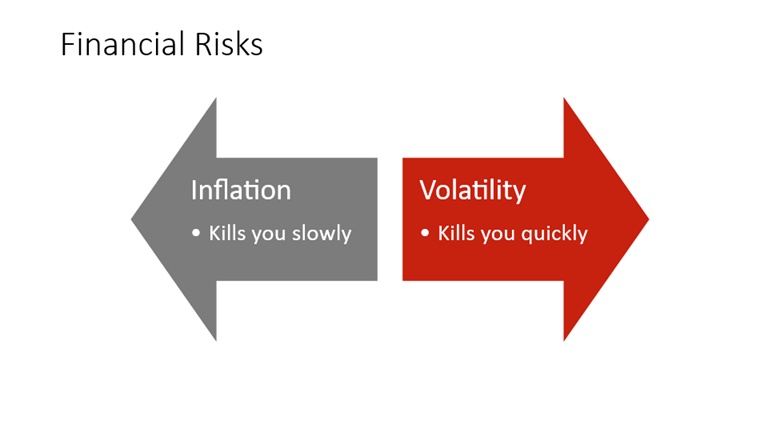
We are entering a time of immense volatility as far as careers and skills are concerned. All of your formerly safe investments in your career are now penny stocks, NFTs, and crypto. This means you need to reassess what is still safe, what isn’t, and diversify your portfolio of skills and career investments. Power BI is just one investment. It is not and cannot be your career anymore.
What to invest in?
Here are my current thoughts on where you should be spending your time and focus if you are starting fresh or feeling anxious.
Invest in accountability.
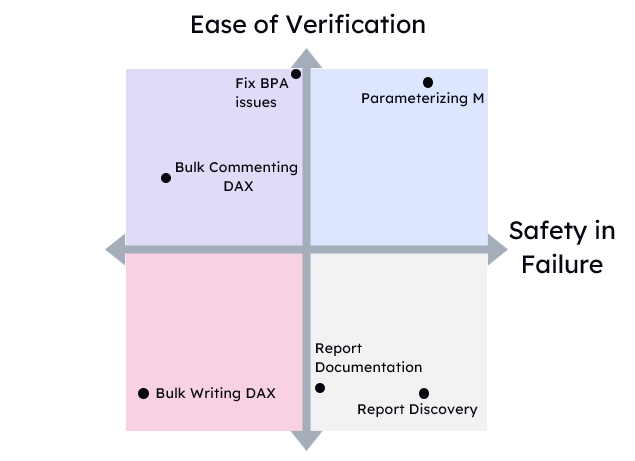
Let’s assume for a moment that AI continues to get really good at data modeling and DAX. My private benchmarks show it’s very good at simple DAX questions and the SQL BI guys have released courses on using DAX with AI.
Imagine now that a number for sales this month is wrong. Maybe it’s a bug. Maybe it’s confusion about how your company handles returns. Maybe there are two competing definitions for what counts as a sale (do returns count, do free trials count, does freight count?). Imagine the CFO uses the report and ends up embarrassed in front of the CEO. Ask yourself, what happens next?.
Someone is going to be responsible. Someone is going to be accountable. For self-service reports, mistakes are often low stakes or easily corrected. Low-stakes work will be replaced with AI. So invest in areas that are high-stakes and high accountability. Invest in data quality, invest in debugging and troubleshooting, invest in DataOps and processes. Invest in CI/CD and automated testing. Invest in regulated industries.
Invest in gut, instinct, and self-expression
There’s a saying that curiosity is self-annihilating. If you follow your curiosity, eventually you’ll lose it by getting the answer.
Skillful use of AI is also self-annihilating. What I’ve found most useful is to develop my nose for code smells. Develop my gut for “That doesn’t sound quite right.” Develop my ability to put into words what is wrong and how I would like it to be different. And AI use robs us of the painful experiences that make those lessons intuitive, subconscious.
There’s an adage: Good judgement comes from experience; experience comes from bad judgement. AI aims to rob us of both experience and bad judgement, leaving us with nothing.
So how do you work against this? First, is to ask the AI to explain the reason it made a decision, provide alternatives and trade offs, and most importantly provide sources. Now to be clear the LLM doesn’t “know” why it did anything. Fundamentally, these tools are pachinko balls bouncing around semi-randomly. But it does force the AI to elaborate in a way that you can learn about tradeoffs and do more research.
Second, build something, anything. By hand. I feel a sort of nihilism sometimes. Why bother when the AI could do it 10 times faster. For the same reason you go to the gym when a forklift could bench press 10x more than you ever could. To build those muscles.
Third, invest in words to express what you want. Learn design, learn vocabulary. I struggle with this mightily when it comes to visuals, UI, and UX. I can tell you something looks bad but I can’t tell you why. Learn the why. Learn how to describe a report with just your words.
Practice with AI, especially when it’s painful and ugly and inferior
AI capabilities grow in the same way that people fall in love or fall asleep: slowly and then all at once.
I’ve seen it with DAX where two years ago the models were making up DAX functions and now, I can’t make single-step DAX questions hard enough to stump frontier models. I’ve seen it recently where I can now give Opus 5.5 the PBIR CLI and the Desktop Bridge feature and it can completely revamp existing reports and they look good. Not great, but good. I’ve seen it recently with Claude Opus 5.5 around motion graphics, video graphics, video games.
Claude used to be infuriating for me to work with when it came to PowerPoint and UI design. It would stick stupid sublabels everywhere. It would clutter the screen. My vibe coded apps (see below) looked like utter trash. But suddenly with Claude Opus 5.5 and Claude Design, it can finally show me a before and after for a proposed UI and even though I don’t have the words for what I want I can get it. Assume in a year this will exist for report visuals.
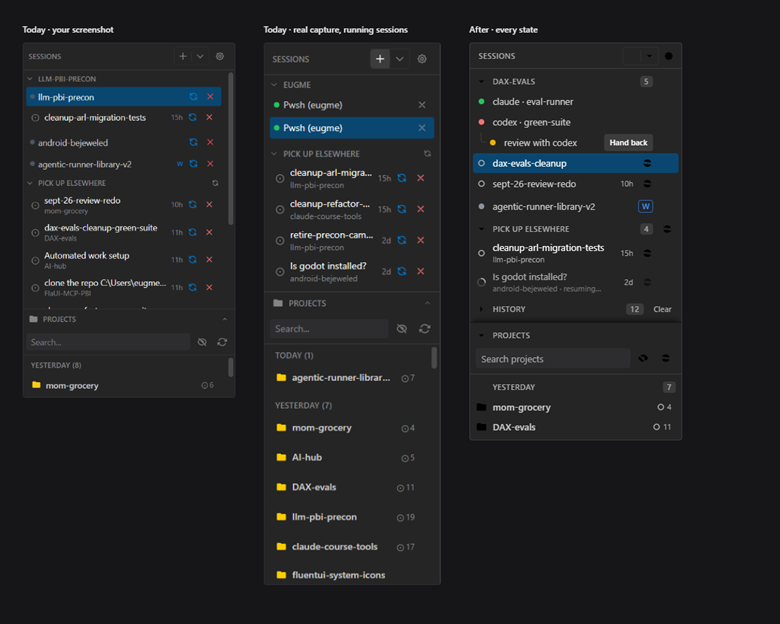
It’s still uneven and frustrating, mind you. The jagged frontier of AI is fractal and immensely jagged. Sturgeon’s law still applies: most of what AI produces is crap. But you don’t want to be blindsided by that other 10%.
I deeply recommend doing something, anything with frontier AI models every week. Test it, break it, ask it to do the impossible. Kurt Buhler has a good video on some of what is possible today with AI and Power BI. Understand the peaks of what is possible while acknowledging most of what it does is the low, low valleys.
Invest in Vega-lite, Vega, and possibly D3.js
Fabric Apps, Power BI Deneb visuals, Snowflake, and Databricks all support Vega-lite. This means you can use it today in Power BI, use it today in Fabric Apps, and it is AI friendly by design. Vega-lite is ideal for an AI heavy world because it is portable, reusable, and it is a code-like grammar of graphics.
Vega is available today in Power BI thanks to the Deneb visual and the ground-breaking work of Daniel Marsh-Patrick. Microsoft has confirmed a native Vega visual is on the roadmap for 2027.
D3 is lower level, but more flexible. You can use it in custom Power BI visuals, Fabric Apps, Qlik, and more. It is worth dipping your toes into D3.js today and being aware of it.
Along similar lines, I would keep an eye on the developing Ossie semantic model format. It’s possible that it may become the Vega of semantic modeling, but right now it’s far too early to say.
Invest in data modeling, data engineering, and requirements gathering
There are things the AI physically cannot know. It cannot know your business and all of its unique intricacies. It cannot know all of the odd and strange exceptions. It cannot know what your users want because even they don’t know what they want until presented with a proof of concept. It will get better at guessing, at interviewing, but I think humans will remain essential here.
An AI can only infer based on the data and context provided. Some may say that’s what ontologies are for, encoding the meaning of the business, but a human somewhere has to build and maintain those ontologies. A human has to go interview Chris in accounting to understand how the business really works. A human should ideally be accountable for getting it wrong.
A semantic model is less a store of data and more an implicit agreement among employees of the business about how the business really works. It is a map of the territory. Always wrong and inferior to reality, but also the best we have got. Be a cartographer.
I think Anthropic’s case study on self-service analytics is instructive here. Just throwing the AI at the data and SQL queries did not work. Just writing the skill files and not maintaining them did not work. Skills had to be maintained alongside the data models and kept up to date. Distractions and wrong choices and wrong models had to be removed or hidden so the AIs wouldn’t get distracted.
We are all gardeners and beekeepers now. Build the environment, monitor for issues. We are trying to collect honey from these strange creatures and desperately hoping not to get stung.